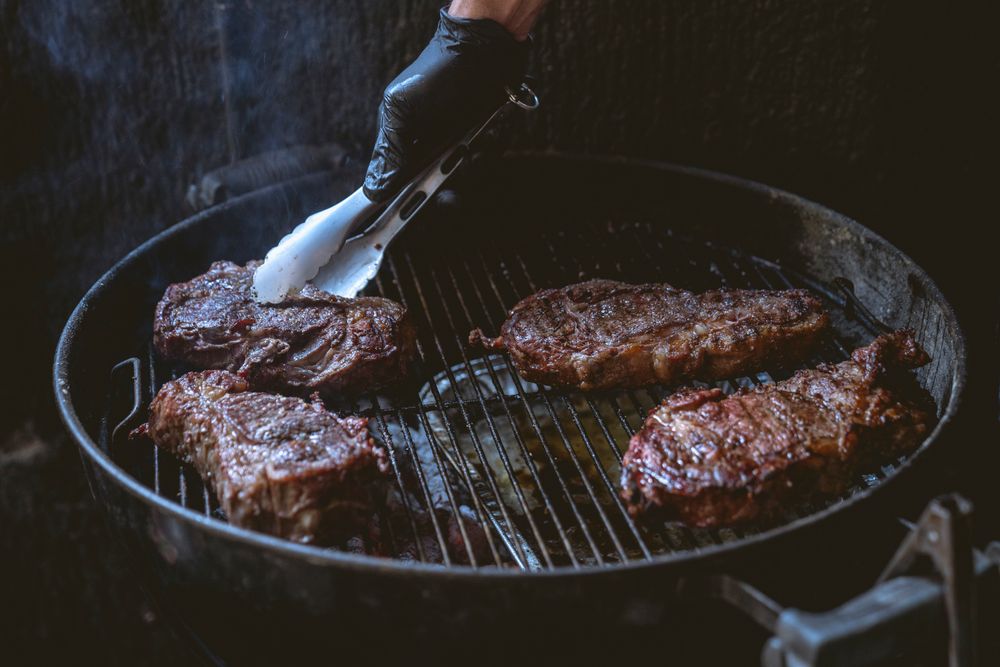
Bank all your lit coals against one half of the grill and leave the other half empty. The coal side runs 230°C (450°F) to 315°C (600°F) for searing, the empty side runs 120°C (250°F) to 175°C (350°F) for cooking through. Start food on the cool side, finish it over the coals.
Step by step
Light a full chimney
Fill a chimney starter and let it burn until the top coals are grey and ashed over, around 12 to 15 minutes. You want all of your fuel lit before you arrange anything.
Bank everything to one side
Pour the entire chimney into one half of the grill. Do not spread the coals thin: you want a deep bed on one side and bare charcoal grate on the other. Charcoal baskets or a Slow 'N Sear will hold the bank in shape for far longer.
Set the vents to direct the heat
Fit the cooking grate and put the lid on with the top vent positioned over the empty side. Heat and smoke are drawn from the coals, across the food and out of the vent, so vent placement is how you steer the airflow.
Let it stabilise, then check both zones
Give it five to ten minutes. Use the hand test: hold your palm five inches above the grate. Two seconds over the coals means searing heat, six or seven seconds on the empty side means a gentle roasting zone.
Cook cool first, hot last
Start thick food on the indirect side with the lid on so it cooks through gently, then move it over the coals at the end for colour and crust. This is the reverse sear, and it is the correct order for almost everything thicker than an inch.
Why a two-zone fire beats an even bed
An evenly spread bed of coals gives you exactly one temperature, and it is a high one. That works for burgers and thin steaks and almost nothing else. Anything thick enough to need real cooking time will burn on the outside long before the centre is done, and you have nowhere to move it to.
A two-zone fire gives you a place to retreat to. Flare-up? Move the food. Skin browning too fast? Move the food. Chicken thigh that needs another ten minutes? Move the food. It converts charcoal cooking from a race into something you can control.
What temperature is each zone?
| Zone | Typical range | What it is for |
|---|---|---|
| Directly over the coals | 230°C (450°F) to 345°C (650°F) | Searing, crust, grill marks, charring |
| Edge of the coal bank | 175°C (350°F) to 230°C (450°F) | Sausages, chops, anything that needs colour and time |
| Indirect side, lid on | 135°C (275°F) to 190°C (375°F) | Roasting whole birds, cooking thick cuts through |
| Indirect side, vents choked | 105°C (225°F) to 135°C (275°F) | Low and slow barbecue |
How do I make the indirect side cooler?
- Close the bottom vent further. Airflow controls fuel burn rate, which controls temperature. Move it a quarter at a time and wait fifteen minutes before judging.
- Use fewer coals. Half a chimney instead of a full one.
- Add a water pan on the indirect side. Water cannot exceed 100°C (212°F), so it absorbs energy and damps down swings.
- Raise the food further from the fire with a second grate level or an elevated rack.
Which side does the lid vent go?
Over the food, on the indirect side. The bottom vent lets air in at the coals, the top vent lets it out, and everything in between travels across whatever is in the way. Putting the top vent over the coals means heat and smoke go straight up and out without passing the food.
Two charcoal baskets cost around twenty five dollars and keep the coals banked in a tight pile instead of slumping across the bowl. A banked pile that holds its shape stays a two zone fire for an hour; a loose one flattens into an even bed in twenty minutes.
Common questions
Can I do a two-zone fire on a small portable grill?
Within limits. On a 14 to 18 inch grill you can bank coals to one side, but the cool zone is small and not very cool, because it is only inches from the fire. It works for chicken pieces and sausages, less well for a whole bird.
Should the lid be on or off?
On, for two-zone cooking. The lid is what makes the indirect side work: it traps convected heat and circulates it around the food. With the lid off, the indirect side is barely cooking at all.
How long does a two-zone fire last?
A full chimney of briquettes gives roughly an hour of useful cooking heat, less with lump. For longer cooks, either add lit coals as you go or use the snake or Minion method instead.
Related guides
 Technique
How to Light Charcoal Without Lighter Fluid
There is one right way to light charcoal, it costs about twenty five dollars, and it takes fifteen minutes.
 Technique
The Snake Method: Low and Slow on a Kettle
A line of unlit briquettes, lit at one end, burning along at about an inch an hour. It is the cheapest smoker you will ever build and it is already inside your kettle.
 Technique
The Minion Method Explained
Fill the basket with unlit charcoal, drop a few lit coals on top, and let the fire eat downward through the pile for the rest of the day.