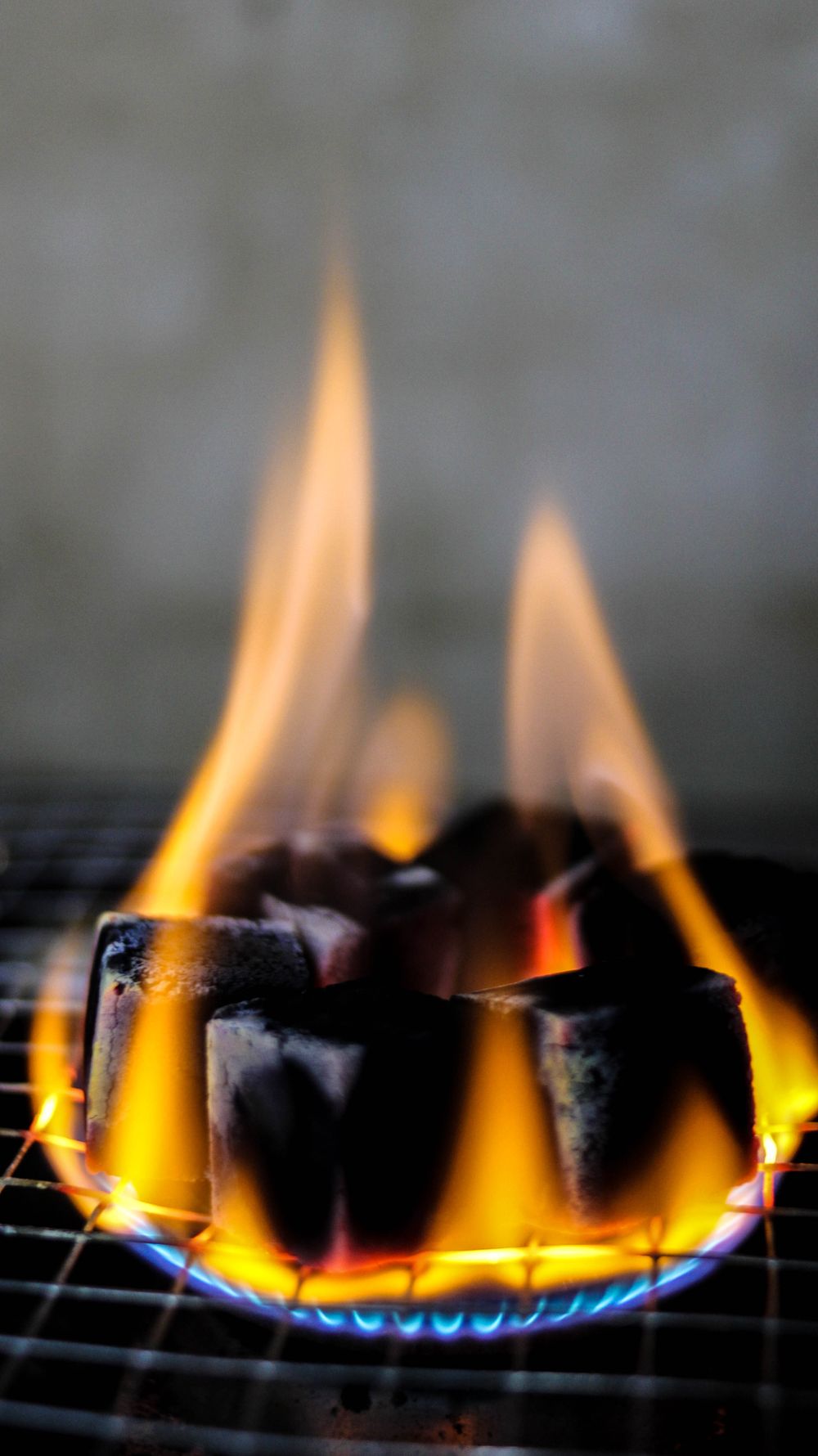
Use lump charcoal for high heat and short cooks: it lights faster, burns hotter and leaves less ash. Use briquettes for long, temperature-controlled cooks: they are uniform, burn longer and hold a steadier temperature. Most people should own both.
What is the actual difference?
Lump charcoal is wood that has been carbonised in a low oxygen kiln until only the carbon skeleton remains. It is irregular, comes in whatever shapes the original timber was, and contains nothing but charred wood.
Briquettes are charcoal fines and sawdust compressed into a uniform pillow shape with a binder, usually starch, and often with additional mineral content to help them light and burn evenly. That manufacturing is not a defect: it is what makes them predictable, and predictability is the entire point of a briquette.
Lump charcoal vs briquettes compared
| Lump charcoal | Briquettes | |
|---|---|---|
| Peak heat | Higher, often 370°C (700°F)+ at the grate | Lower, typically 260°C (500°F) to 315°C (600°F) |
| Time to light | 10 to 12 min | 12 to 15 min |
| Burn duration | Shorter, roughly 1 to 1.5 hr usable | Longer, roughly 2 hr usable |
| Temperature stability | Fluctuates, irregular pieces | Very steady, uniform pieces |
| Ash produced | Low | High, can choke vents on long cooks |
| Consistency bag to bag | Variable | Highly consistent |
| Smoke character | Cleaner, faint wood sweetness | More neutral, noticeable start-up smell |
| Reusable after a cook | Yes, easily | Yes, but more ash to sieve |
| Cost per cook | Higher | Lower |
When to use lump charcoal
- Searing steaks and anything that wants 315°C (600°F) or more.
- Kamado cooking. Ceramic cookers want lump, and briquette ash clogs the small base vent.
- Short high heat cooks where the extra heat matters more than the duration.
- When you want the cleanest possible smoke, for instance under fish or vegetables.
- Any cook where you plan to shut the vents and reuse the fuel afterwards.
When to use briquettes
- The snake method and the Minion method. Both depend on uniform size and predictable burn, which lump cannot provide.
- Long low and slow cooks where holding 120°C (250°F) for ten hours matters more than peak heat.
- Any recipe that specifies a number of coals, since that count assumes briquettes.
- Cooking for a crowd where consistency matters more than the last hundred degrees.
Do briquettes contain nasty chemicals?
This is the most repeated claim in the argument and it is largely overstated. Standard briquettes contain charcoal, sawdust, a starch binder, and mineral additives such as limestone and borax that regulate burn rate. None of those are harmful in a fully ashed-over fire, and by the time the coals are grey the binders have burnt off.
What genuinely does taint food is lighter fluid, and match-light or instant-light briquettes, which are pre-soaked in exactly that. Avoid those specifically rather than briquettes as a category. If the additives still bother you, several brands including B&B and Weber make briquettes with no petroleum binders at all.
Keep a bag of each. Briquettes for barbecue and any cook where you need to hold a number for hours; lump for grilling, searing and kamado work. They cost roughly the same to keep in the shed and they are genuinely better at different jobs.
Common questions
Which burns hotter, lump or briquettes?
Lump, comfortably. Dense hardwood lump such as quebracho can push past 370°C (700°F) at the grate, where briquettes typically top out between 260°C (500°F) and 315°C (600°F). That difference is what makes lump the better searing fuel.
Which lasts longer?
Briquettes, by roughly 30 to 50 percent for the same weight. They are denser and burn more slowly, which is why every long-cook technique is written around them.
Can I mix lump and briquettes?
Yes, and plenty of people do: briquettes as the steady base with lump added for a heat boost when searing. The one place not to mix them is the snake method, where irregular lump breaks the even burn.
Does lump charcoal taste better?
It produces cleaner smoke with a faint sweetness, and briquettes have a more noticeable smell during lighting. Once both are fully ashed over the difference in the finished food is subtle, and far smaller than the difference wood chunks make.
Related guides
TechniqueHow to Light Charcoal Without Lighter Fluid
There is one right way to light charcoal, it costs about twenty five dollars, and it takes fifteen minutes.
 Technique
How to Set Up a Two-Zone Fire
One fire, two temperatures, and suddenly a charcoal grill can do everything an oven and a frying pan can do together.
 Technique
The Snake Method: Low and Slow on a Kettle
A line of unlit briquettes, lit at one end, burning along at about an inch an hour. It is the cheapest smoker you will ever build and it is already inside your kettle.