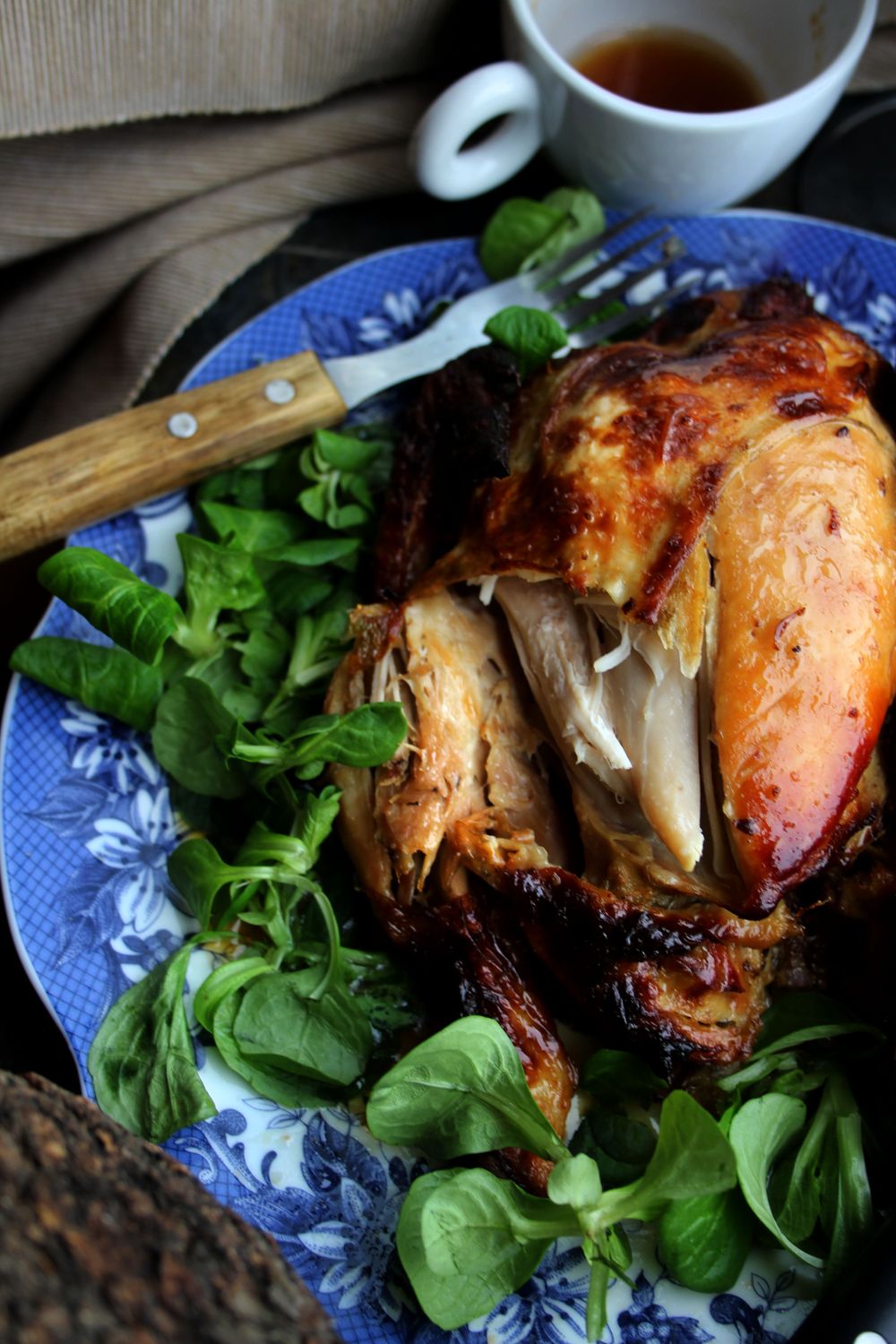
Cut out the backbone, flatten the bird, and dry-brine 4 hours or overnight. Cook skin side up on the indirect side at 190°C (375°F) for about 45 minutes until the breast reads 70°C (160°F), then move it over the coals skin down for 3 to 5 minutes to crisp. Done at 75°C (165°F) breast, 80°C (175°F) thigh.
Method
Spatchcock the bird
Put the chicken breast side down. With sturdy shears, cut up each side of the backbone and remove it entirely. Flip the bird over and press hard on the breastbone with the heel of your hand until it cracks and the bird lies flat. Keep the backbone for stock.
Dry-brine with baking powder
Mix the salt, baking powder and spices, and rub over the whole bird, concentrating on the skin. Leave uncovered on a rack in the fridge at least 4 hours, ideally overnight. Baking powder raises the skin's pH, which speeds browning and makes it noticeably crisper. Use baking powder, not bicarbonate of soda, which tastes soapy.
Two-zone at 190°C (375°F)
Bank a chimney of coals to one side and add the wood chunk. You want around 190°C (375°F), which is hot enough to render and crisp the skin but gentle enough that the thighs finish before the breast dries.
Indirect, skin side up
Lay the bird flat on the cool side, skin up, legs pointing towards the coals since thighs want more heat than breasts. Lid on, vent over the bird. Around 45 minutes.
Watch the breast, not the clock
Probe the thickest part of the breast, avoiding bone. At 70°C (160°F) you are ready for the final step. The thighs will be running 15 to 20 degrees hotter, which is exactly what you want, since dark meat is better at 80°C (175°F).
Crisp over the coals
Move the bird skin side down directly over the bank for three to five minutes. Watch it constantly, because rendered fat plus direct flame goes from golden to black quickly. Pull at 75°C (165°F) in the breast.
Rest 10 minutes and joint
Rest skin side up so it stays crisp, then cut into legs, thighs, wings and breast halves.
Notes worth knowing
- Save every backbone in the freezer. Four of them make the best chicken stock you will ever have.
- If the skin is flabby, it was wet when it went on. The overnight uncovered fridge stage does more for crispness than anything you do at the grill.
- A chicken is done by temperature, not by clear juices, which is an unreliable test.
Common questions
Why not beer can chicken?
The beer never reaches a temperature where it meaningfully evaporates into the cavity, so it does not baste anything. It also holds the bird upright with the thick thighs at the top, away from the heat, which is backwards. Spatchcocking cooks faster and more evenly.
Is 75°C (165°F) really necessary?
75°C (165°F) is instant pasteurisation, so it is the safe simple number. The same lethality is achieved by holding 70°C (155°F) for about a minute, which is why some cooks pull earlier. For the breast, 70°C (160°F) with carryover to 75°C (165°F) is the practical target.
Cook these next
 Whole bird
Jerk Chicken Over Charcoal and Pimento Wood
Real jerk is a smoking technique, not a sauce. The marinade matters, but what makes it jerk is slow smoke over pimento wood.
Thighs and legsTandoori Chicken Without a Tandoor
Two marinades, not one. The first is salt, lemon and chilli cutting into scored meat; the second is yoghurt and spice clinging to the surface. That order is the whole technique.
Whole birdWhole Roast Chicken on Charcoal (Better Than Beer Can)
Beer can chicken does not work, for reasons of basic physics. Here is the whole roast chicken it is trying to be, cooked upright on a proper roasting stand.