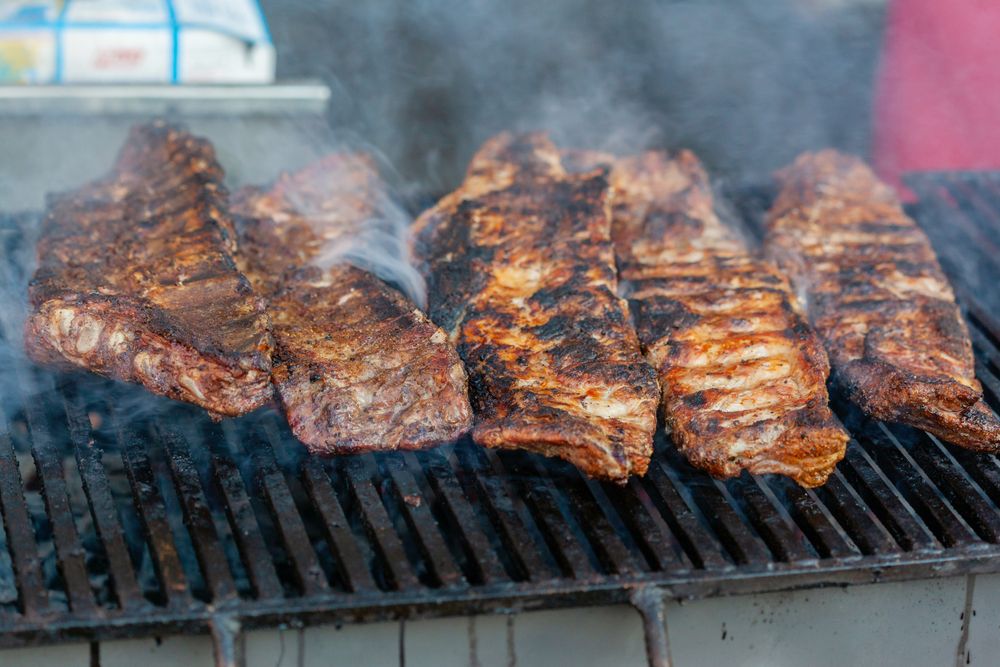
Light a small fire in a full load of lump, open the vents to climb slowly, and start closing them well before you reach your target so you do not overshoot. Use a heat deflector for indirect cooking. It will then hold that heat for hours.
Step by step
Fill it with lump
Fill the firebox with lump charcoal, not briquettes, whose fine ash clogs the bottom vent. You are lighting a small part of a large load that will burn slowly.
Light a small fire
Light the lump in one or two spots only, with a firelighter or a small amount of lit coals. You want a modest fire that grows, not the whole load alight at once.
Creep up on the temperature
Open the top and bottom vents a little and let the temperature climb slowly. The golden rule: start closing the vents well before you reach your target, not when you hit it. A kamado is slow to come back down once it overshoots.
Set up direct or indirect
For searing, cook directly over the coals. For low and slow or roasting, drop in the ceramic heat deflector to shield the food from direct heat and turn the kamado into an oven.
Let it hold
Once settled, a kamado holds its temperature with almost no attention for hours, barely affected by wind or rain. Resist fiddling; small vent changes take a long time to show on a cooker with this much thermal mass.
Why a kamado is different
The thick ceramic is a heat battery. Once up to temperature it resists change, holding low heat overnight on a single load and sipping fuel. That stability is the appeal, but it also means the cooker is slow to respond, so you steer it gently and early, not with sharp last-minute corrections.
The overshoot trap
The one mistake beginners make is letting the temperature run past their target, then chasing it back down for an hour. Because the ceramic holds heat, coming down is slow and painful. Always sneak up on your number and close the vents early; it is far easier than recovering from an overshoot.
At the end of a cook, close every vent completely. The airtight ceramic suffocates the fire and leaves the unburnt lump intact for next time. Over a season this makes a kamado remarkably cheap to run.
Common questions
Can I use briquettes in a kamado?
Better not. Briquette ash is fine and clogs the small bottom vent, choking the fire. Use lump charcoal, which also lets you snuff and reuse the fuel, keeping running costs low.
How do I cook low and slow on a kamado?
Fit the ceramic heat deflector for indirect heat, light a small fire, and settle it at a low temperature, creeping up and closing the vents early. It will then hold that heat overnight with almost no attention.
Related guides
 Technique
How to Light Charcoal Without Lighter Fluid
There is one right way to light charcoal, it costs about twenty five dollars, and it takes fifteen minutes.
 Technique
How to Set Up a Two-Zone Fire
One fire, two temperatures, and suddenly a charcoal grill can do everything an oven and a frying pan can do together.
 Technique
The Snake Method: Low and Slow on a Kettle
A line of unlit briquettes, lit at one end, burning along at about an inch an hour. It is the cheapest smoker you will ever build and it is already inside your kettle.