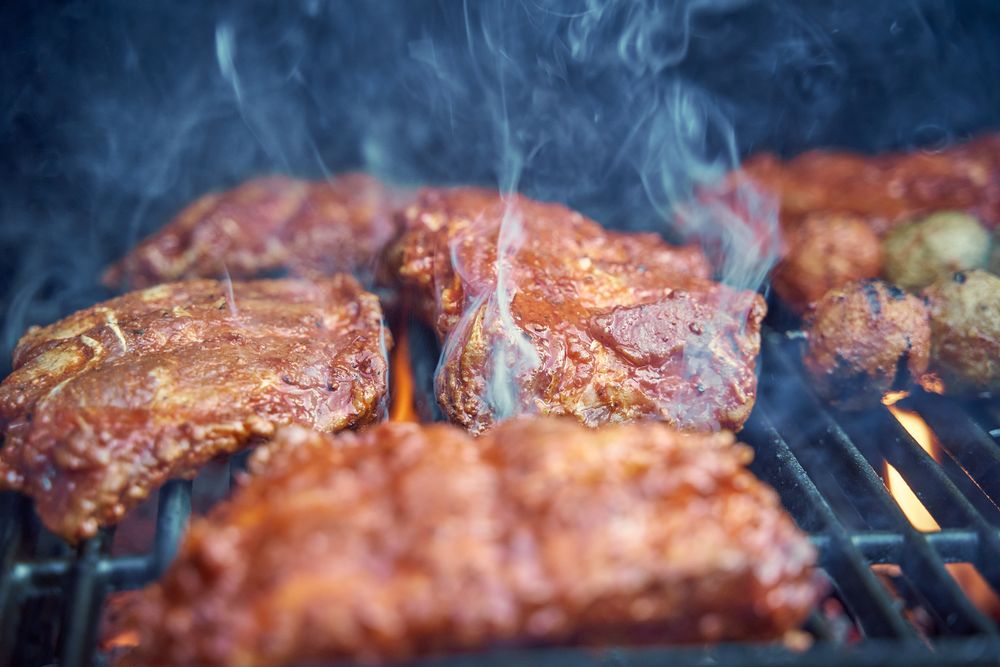
Season a plate of beef short ribs with equal salt and coarse pepper. Smoke bone side down at 120°C (250°F) to 135°C (275°F) for 7 to 9 hours until they reach 95°C (203°F) and probe like butter. Do not wrap. Rest 45 minutes.
Snake or Minion method, held at 120°C (250°F) to 135°C (275°F), with oak or hickory.
Method
Buy the right cut
You want plate short ribs, sometimes sold as dino ribs, with thick meat sitting on top of the bone. Avoid flanken-cut or thin chuck ribs, which have far less meat and will dry out over a long cook. Leave the fat cap on and only remove the hard silverskin on top if it is thick.
Season heavily
Equal parts coarse salt and coarse pepper on every surface including the bone side. Beef short rib carries a lot of fat and needs aggressive seasoning to balance it. Leave the membrane on the bone side; unlike pork ribs it holds the meat together here.
Set the fire for a long steady run
Build a snake in a kettle or a Minion pile in a bullet smoker, targeting 120°C (250°F) to 135°C (275°F). Slightly hotter than brisket is deliberate: the fat content is higher and the cut is more forgiving, so you can push the pace without drying it.
Smoke bone side down, no wrap
Put the ribs bone side down and leave them there for the whole cook. The bone shields the meat from the fire and there is no reason to turn them. Unlike brisket, short ribs have enough intramuscular fat to get through the stall without wrapping, and an unwrapped bark is much better.
Spritz if the bark looks dry
From hour three, if the surface is looking dry rather than glossy, spritz lightly with water or beef stock every 45 minutes. If it looks fine, do nothing. Spritzing cools the surface and slows the cook, so it is a tool rather than a routine.
Cook to feel
From 90°C (195°F) start probing between the bones. You want the probe to slide in with no resistance at all, typically around 95°C (203°F). The meat should have pulled back from the bone by half an inch or so and jiggle when you nudge it.
Rest and serve whole
Rest 45 minutes loosely tented. Serve as whole bones, one per person, and let people cut their own. Slicing them thin is a waste of the drama.
Notes worth knowing
- If your butcher only has chuck short ribs, they still work but check them from 90°C (190°F), they cook considerably faster.
- Beef tallow brushed on in the last hour deepens the bark and adds shine without steaming it the way a wrap does.
- These are richer than brisket. Serve with something sharp: pickled onion, mustard, or a vinegar slaw.
Common questions
Why not wrap beef short ribs?
They carry enough fat to push through the stall on their own, and the bark is the best part. Wrapping softens it for a modest time saving that is not worth making here.
How do I know they are done without a thermometer?
Probe between the bones with a skewer. If it goes in like the meat is not there, they are ready. If there is any push-back, give them another 45 minutes and check again.
Cook these next
 Ribs
RibsBaby Back Ribs on a Charcoal Kettle
The cook that teaches you fire management, because five hours at 135°C (275°F) on a kettle is entirely achievable and entirely on you.
 Short rib
Korean Galbi, LA-Cut Short Ribs
Short ribs cut thin across the bone so they cook in minutes. The marinade uses pear, which genuinely tenderises rather than just flavouring.
Short ribAsado de Tira Over Embers
Argentinian cross-cut short ribs cooked slowly over embers rather than flame, seasoned with nothing but coarse salt. Patience is the entire recipe.